



Have you ever found yourself re-explaining the same feature to someone who was supposedly already up to speed? Do meetings start with a developer whose name you recognize, but whose responses suddenly feel off or disconnected? Has progress stalled just when it felt like things were finally moving forward?
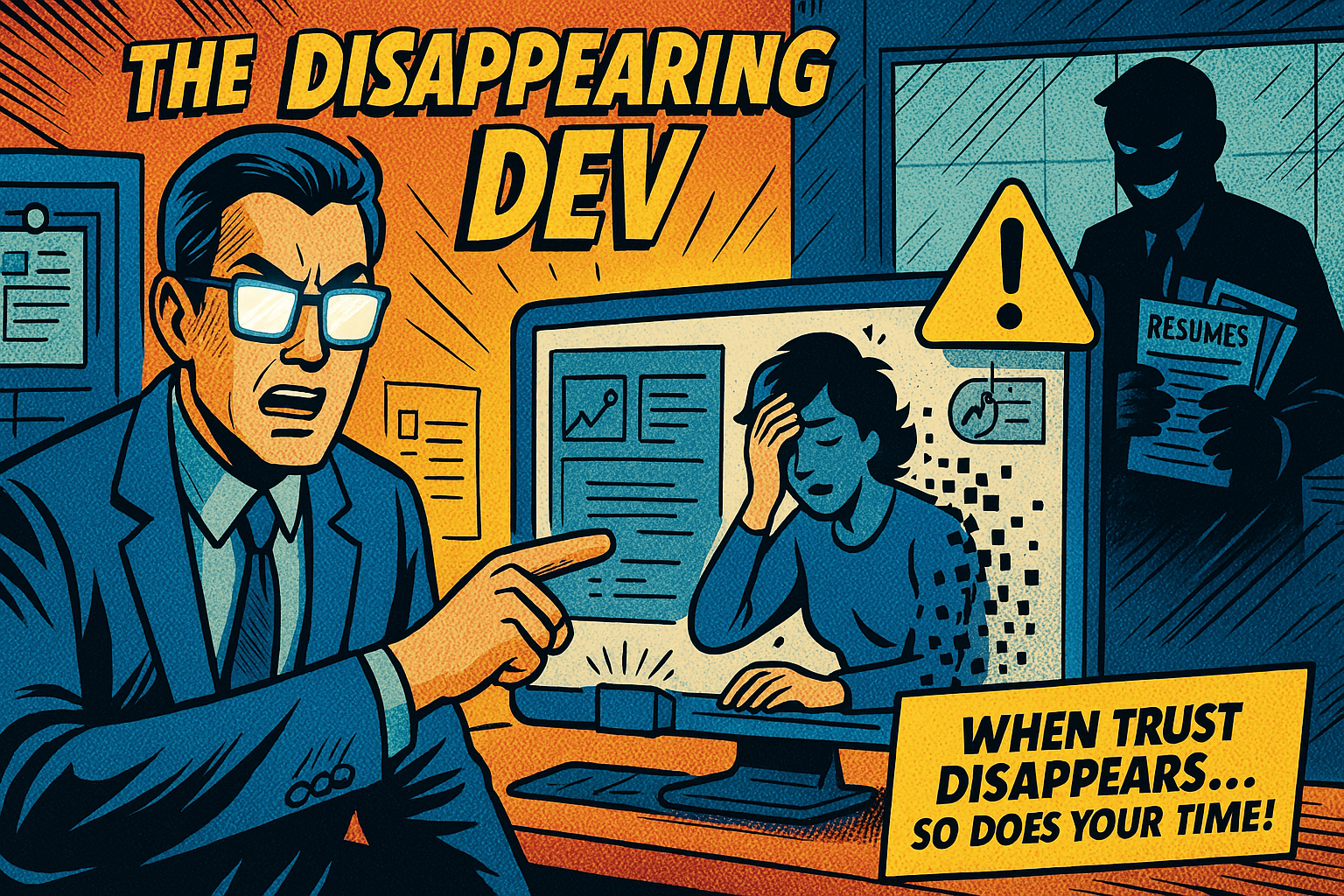
If you’ve experienced any of this, you may be dealing with an all-too-common but rarely discussed issue: your software vendor is secretly swapping developers without your knowledge or approval. These swaps are done quietly—sometimes even hiding behind the same name, same user account, and same email signature—and they can cost you time, quality, and trust.
Developer changes do happen, but when they become frequent, unannounced, and deliberately concealed, that’s a serious red flag. Vendors may be juggling their best people across multiple projects, overpromising to clients and rotating resources in the background to keep up appearances.
To make these changes harder to detect, developers often continue using the same login credentials, commit accounts, and communication profiles. One common tactic is keeping cameras off during video calls, hiding the identity of whoever is actually doing the work. You might think you’re speaking to the same developer week after week—but suddenly they’re slower, asking questions about things they previously understood, or making avoidable mistakes. That’s not the same person. You just weren’t told they’d been swapped out.
These stealthy substitutions allow vendors to stretch teams beyond their limits, leaving your project to absorb the hidden cost: repeated onboarding, lost context, and constant disruption.
Even if swaps are being hidden, you can still pick up on the clues. Watch for these patterns:
If your project feels like it’s constantly rebooting—like you’re always starting over even with the "same" team—this could be why.
You don’t have to become a detective, but you can build safeguards that protect your project from quiet disruptions.
Ask your vendor directly: “Will these same developers be assigned to our project for the next three to six months?” Look for a clear answer—not vague reassurances.
Meet every new team member over video, with cameras on. It’s not about micromanagement—it’s about transparency. If someone avoids this, ask why.
Request that each assigned developer is named in your contract or work order. It gives you visibility, and makes it harder for vendors to swap people behind the scenes without informing you.
Watch who shows up consistently, leads conversations, and provides updates. If participation becomes inconsistent, bring it up early.
Ask how transitions are handled if a developer needs to leave. Is there a documented handover process? What steps are taken to protect your project’s continuity?
When developers are rotated out in secret, your project suffers quietly and repeatedly.
If you feel like something’s off—even if the names haven’t changed—it might not be your imagination. It could be a silent swap happening behind the scenes.
By asking for real transparency, insisting on face-to-face accountability, and keeping your vendor honest about who is doing the work, you take control of your timeline, your delivery, and your outcome. Because behind every project delay, there’s often more going on than meets the eye.