

%203fs.png)


Finding, attracting and onboarding talented workers is challenging. This is particularly the case in the technology sector, where job offers abound (by the way, we’re hiring!) and highly skilled software developers are as selective as they want about where to work.
This insufficient supply and extremely high demand for IT workforce is incredibly hard for companies that need to expand their existing teams quickly.
One strategy that has become increasingly popular to address this is staff augmentation, also known as team augmentation.
Staff augmentation is hiring external skilled developers to supplement an organization’s in-house development team on a temporary or project basis.
Companies that choose this outsourcing model will usually pay only the agreed-upon fee, with no additional administrative costs, for the duration of the contract.
The outsourcing vendor will ensure a good fit between the professionals and the clients, deal with hiring employees and all the paperwork, provide office space, HR management, salary payments, etc.
Finally, the professionals involved will be leased out and incorporated into the existing in-house team, following their internal processes and company culture while contributing with their specialized knowledge, skills, and experience.
The main difference lies in the level of involvement businesses have in the IT processes and workforce.
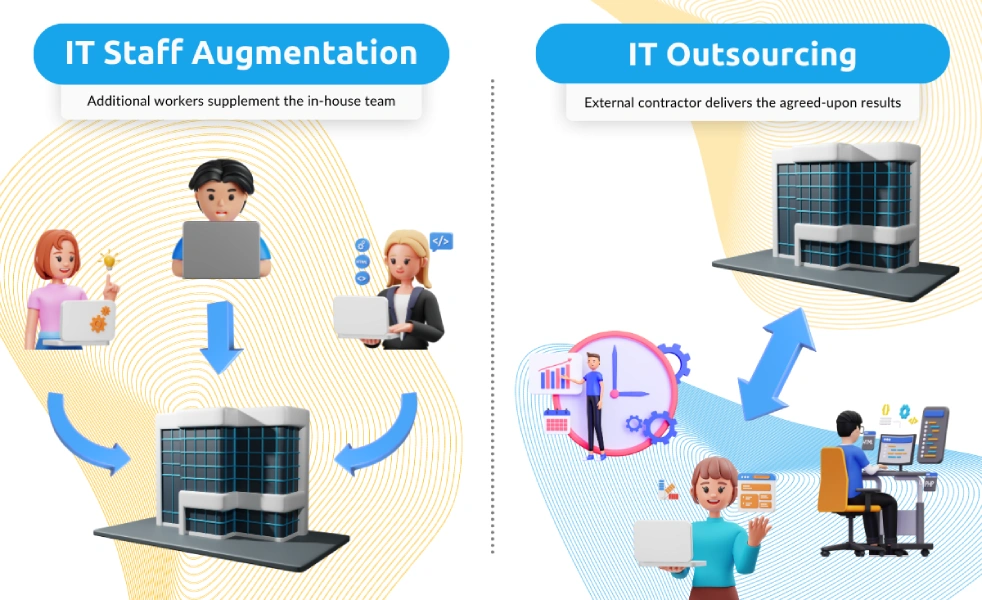
Staff augmentation involves bringing in external professionals on a temporary or project basis to complement the existing IT team. The augmented staff works inside the client company, collaborating directly with the in-house software developers under the organization’s supervision and management. This approach allows companies to maintain processes under a consistent work culture while flexibly scaling resources.
On the other hand, IT outsourcing involves hiring a company to conduct software development independently. In this model, the project outsourcing company takes on the responsibility of delivering the agreed-upon solutions, and in doing so, the cooperation ends. Project outsourcing is focused on results and allows leveraging different areas of expertise that the company looking to outsource work may not need or want inside their team.
This will be a good choice for you if you need highly skilled and/or specialized workers for a limited time or until a specific project is completed, and you need the flexibility to increase or decrease headcount on short notice.
It is also an excellent fit for organizations aware of the costs of recruiting tech talent and don’t have the resources to do this properly (e.g. technical interviews, assessment of tech expertise, etc).
Here are some use cases that are particularly well-suited for team augmentation:
If you came this far in the article and decided that IT staff augmentation is a good fit for you, that’s great! Now, you need to know how to properly implement it in your company to ensure a smooth transition and avoid the potential downsides we mentioned earlier.
Here is a step-by-step guide to help you navigate the process:
Begin by defining the roles and skill sets that you need. Identify the goals you aim to achieve and the skill gaps you wish to fill. The idea is to start with a clear view of what you expect from this investment. Be as specific and detailed as possible.
Now that you understand why you need staff augmentation, it’s time to consider the more practical issues of time, money, and effort allocation.
These are essential factors that the contractor needs to know to give you an accurate proposal.
This step is critical. Consider the company’s portfolio, services, reputation, client reviews (Clutch is excellent for this), the company’s culture, and the range of skills they can offer. Reach out to previous clients and conduct thorough evaluations before making a decision.
Of course, at this stage, you will also evaluate each proposal and see which ones best fit your budget and expectations. You don’t want any surprises down the road!
The augmented staff won’t work in a vacuum – ensuring that all colleagues and stakeholders are prepared to welcome them into the team and work together efficiently is crucial. Communicate to the in-house team why the company decided to invest in staff augmentation instead of expanding the team through traditional hiring, what the additional staff will do, what will change and what will stay the same.
While onboarding augmented IT staff will generally be faster and easier than a traditional hiring model, it is still necessary. Provide access to all necessary resources, tools, and documentation to ensure the new team members have everything they need to achieve their goals.
More often than not, a dedicated team will be fully remote. In such cases, having effective communication channels is indispensable. Leverage messaging, video conferencing, and other online collaboration tools to facilitate information sharing.
This step applies to the client as well as the contractor. Both companies should regularly monitor the performance of augmented IT staff and provide constructive feedback. This ensures continuous improvement and alignment with project objectives.
Evaluating staff augmentation’s return on investment (ROI) is essential for making data-driven decisions and maximizing its positive impacts on your business. Consider cost savings, project timelines, productivity gains, and customer satisfaction.
Despite the benefits, there are common misconceptions and myths surrounding staff augmentation services. Addressing these can help organizations make informed decisions:
By dispelling these misconceptions, organizations can embrace staff augmentation as a powerful tool for maximizing efficiency and productivity.
Staff augmentation can be an excellent business strategy to enhance operational efficiency and productivity.
By leveraging external expertise, organizations can access specialized skills, address resource gaps, and foster innovation.
Companies must choose the right provider to implement staff augmentation service and address potential challenges successfully. Regular ROI evaluation, legal compliance, and performance monitoring are essential for long-term success.
If all of this makes sense to you, it’s time to embrace IT staff augmentation as a strategic solution to unlock your organization’s full potential!

%202.png)