
%203fs.png)


In the realm of IT entrepreneurship and software development, mastering time management and accurate task estimation is pivotal for project success. This article explores the common challenges faced in estimating project timelines, delves into the cognitive biases and psychological factors influencing our estimates, and underscores the significant repercussions of unrealistic time estimations in the context of managerial roles like CEOs, CTOs, and PMs.
Article created in cooperation with Mateusz Sobieraj.
Time estimation is a critical aspect of time management. However, unfortunately, it is complicated by cognitive biases and psychological factors. Understanding and addressing these pitfalls is essential for improving productivity, reducing stress, and fostering a culture of productivity within organizations.
Various cognitive biases and psychological factors often undermine the ability to estimate the length of tasks, leading to a host of detrimental consequences for managers and their teams.
The Planning Fallacy, as identified by psychologists Daniel Kahneman and Amos Tversky, is a phenomenon where individuals tend to underestimate the time, costs, and risks of future actions while overestimating the benefits.
However, it's worth noting that this mistake applies to forecasts for one's own tasks. External observers often show a pessimistic bias toward other people's tasks, overestimating the time needed.
This bias leads managers to make overly optimistic time estimations, turning hours into minutes, focusing on best-case scenarios, and neglecting potential obstacles or unexpected challenges that could arise. As a result, deadlines are consistently underestimated, leading to rushed work, increased stress within the team, and compromised quality.
Coupled with the Planning Fallacy is the Optimism Bias, which causes individuals to believe that outcomes will be more favorable than they realistically are.
This bias skews time estimations, making managers overly optimistic about their abilities to complete tasks within set timeframes. When reality sets in, and responsibilities take longer than expected, it can lead to stress, procrastination, and a cycle of unmet deadlines.
Parkinson's Law further exacerbates the challenges of time estimation. It states that work expands to fill the available time. When a deadline is set, individuals tend to adjust their pace of work and effort accordingly.
For instance, if a team is given two weeks to complete a project, they may pace themselves and allocate work in a way that fills the entire two-week period, even if the work could potentially be completed in a shorter timeframe or procrastinate until the last day before the deadline.
Unrealistic estimations have far-reaching consequences for managers and employees. Rushing to meet underestimated deadlines can increase stress levels, leading to burnout and reduced team morale.
Moreover, poor time estimations erode trust and credibility, both internally within teams and externally with clients or stakeholders. Consistently missing deadlines due to inaccurate planning can damage a manager's reputation and jeopardize the long-term success of projects and organizational initiatives.
Effective time management hinges on ability to navigate the inherent biases and challenges associated with time estimation. By implementing strategies with discipline, integrating time buffers into our plans, leveraging historical data, and adopting a structured approach to task management—managers can enhance skills to estimate time effectively.
.webp)
It's prudent to incorporate time buffers into our estimates to counteract our tendency to underestimate task duration. Adding a conservative 15–20% buffer to initial estimates helps accommodate unforeseen delays or complexities. This buffer acts as a safety net, ensuring we have the time needed to deliver quality results without feeling rushed.
Tip: Encourage your team members to do the same!
Drawing from past experiences and data can provide valuable insights into task durations. Analyzing similar projects or tasks from the past allows us to calibrate our current estimates more accurately. This historical perspective offers a reality check, helping us avoid falling into the trap of over-optimism.
Breaking down complex tasks into smaller, manageable subtasks facilitates more precise time estimates. By focusing on individual components, we gain a clearer picture of the work involved and can allocate time accordingly. This approach also aids in prioritization and resource allocation.
Grouping similar tasks leverages efficiency and minimizes context-switching. By tackling related activities consecutively, we capitalize on the momentum and familiarity within a specific domain. This strategy optimizes workflow and conserves foucus and mental energy.
Regularly assessing and adjusting time estimation strategies based on performance metrics and feedback fosters continuous improvement. Being open to refining our approaches based on real-time data and experience enhances our ability to forecast accurately.
.webp)
Two of the most popular time management strategies used by professionals today are time blocking and time boxing. These methods provide structured approaches to organizing tasks and maximizing productivity within designated time frames.
Understanding the nuances and benefits of each strategy is essential for managers seeking to optimize their workflow and achieve set goals efficiently. Let's explore the principles and applications of time blocking and time boxing to determine which approach aligns best with your productivity needs.
Time blocking is a time management technique in which you divide your day into blocks of time dedicated to specific duties or activities. The idea is to allocate a set amount of time for each activity or group of activities, allowing you to focus completely on those tasks during that designated period. Time blocking helps you organize your day more effectively and improves productivity by providing structure and reducing distractions.
.webp)
E.g. Morning routine and workout, then work in deep concentration, then a block of operational work and writing off messages, then a series of meetings, and finally reviewing your task list and setting a priority for the next day.
Time boxing is another effective time management technique that involves setting specific time limits, or "boxes," for tasks or activities. Unlike time blocking, which focuses on allocating fixed blocks of time for tasks, time boxing emphasizes completing tasks within predefined time frames. The key principle of time boxing is to work within a set period, regardless of whether the task is fully completed within that time. This technique promotes focus, urgency, and productivity.
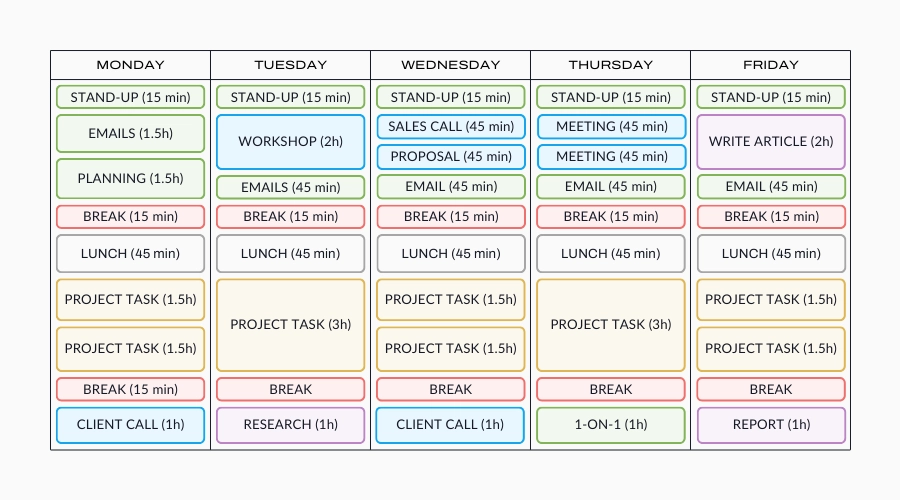
Time management techniques like time boxing and blocking can be game-changers for productivity, but implementing them effectively requires finding the right balance between structure and flexibility. Let's explore two approaches and how you can tailor them to fit your needs.
Cal Newport's method is all about meticulous planning. Picture your day as a well-orchestrated schedule with designated time blocks for every activity, including commuting. It's a beautiful, detailed plan that aims to maximize productivity by allocating specific time slots to each task.
However, as Newport acknowledges, the real world is unpredictable. Urgent tasks can crop up, and issues in one block might spill over into others. The key here is adaptability. Newport's approach anticipates these disruptions. Instead of clinging rigidly to the plan, Newport suggests taking 1–2 moments during the day to reassess and adjust your schedule based on what's happening.
Sobieraj's approach offers a more relaxed take on time blocking. Rather than micromanaging every minute, Sobieraj divides the day into broader blocks like "Morning Training," "Deep Work," and "Operational Work." Within these blocks, the specifics can vary based on daily demands. For instance, the "Operational Work" block might include tasks like emails, phone calls, or meetings, depending on what arises that day.
This approach provides a general framework while allowing for spontaneity. Critical blocks, like dedicated time for deep focus work, remain sacred, ensuring that essential tasks receive priority while maintaining room for adjustment.
If you're new to time blocking, start with a manageable approach. Block out 2–3 time slots in your calendar next week for deep work or focused tasks. Begin by identifying your top priorities for the day or week and allocate dedicated time for them. Break down large tasks into smaller, actionable steps to make them more manageable and approachable.
Regardless of which approach you choose, there are universal strategies for successful implementation:
Good practices for implementation:
Whether you prefer a meticulously planned schedule like Newport's or a more flexible approach like Sobieraj's, the key lies in finding a method that suits your style and allows for adaptation to the inevitable surprises of daily life. Start small, stay adaptable, and watch your productivity soar.
If you want to hear real-life examples of individuals and organizations benefiting from these techniques please listen to "Time Management for leaders" with Mateusz Sobieraj.

%202.png)
.webp)